
Criminal Court Records in Blaine County
A Blaine County criminal court record is the case file the Court Clerk opens once a prosecutor files a charge. It is not the arrest report, and it is not the jail booking sheet. The record starts at the moment charges are filed in court, and it grows with each new event. Felony cases carry a CF prefix. Misdemeanor cases carry a CM prefix. The file holds the charging document, bond entries, the arraignment, pleas, motions, hearing dates, the verdict or plea, the disposition, and the sentence. Costs, fees, and payment plans land in the same record. The Blaine County Court Clerk in Watonga keeps these files and is the source for certified copies.
Most criminal cases in the county are heard in the Blaine County District Court, the trial court of general jurisdiction. It handles felony and misdemeanor matters, search warrants, and probable-cause filings in Blaine County. City ordinance and municipal traffic offenses are different. Those are handled by local municipal courts, such as Geary, not the district court. A felony judgment from the district court can be appealed to the Oklahoma Court of Criminal Appeals, the state's highest court for criminal matters. For a wider view of every filing type the clerk keeps, the county Blaine County court records cover civil, family, and probate cases beside the criminal ones.
How to Search Blaine County Criminal Court Records
Two free statewide systems carry Blaine County criminal cases. OSCN, the Oklahoma State Courts Network at oscn.net, runs the official district court docket search. ODCR at odcr.com offers a second county-linked search interface. Both let you pull a Blaine County case by defendant name, by case number, or by case type and filing date.
- Open the OSCN case search at oscn.net and choose Blaine County District Court.
- Search by the defendant's name, or by the exact case number if you have it.
- Narrow the results by case type, such as CF for felony or CM for misdemeanor, and by date range.
- Open the case to read the docket, the charges, and the disposition line by line.
- Request a certified copy from the Court Clerk when you need an official version for legal use.
When a Blaine County record looks thin, sealed, old, or unclear, the Court Clerk's office in Watonga is the controlling source. Reach the clerk at 580-623-5970. For a criminal-history check that reaches beyond one county, the Oklahoma State Bureau of Investigation runs name-based and fingerprint background searches statewide.
Stages of a Blaine County Criminal Case
A Blaine County criminal case moves through set stages, and each one leaves a mark in the docket. Reading the record in order shows where a case stands and how it ended. Some stages happen in minutes. Others span months of hearings and filings.
Case flow: Charges Filed › Arraignment › Pretrial and Motions › Plea or Trial › Disposition › Sentencing
| Stage | What Happens |
|---|---|
| Charges Filed | The prosecutor files a complaint or information, and the clerk opens the case under a CF or CM number. |
| Arraignment | The charges are read in court, the defendant enters a plea, and bond may be set. |
| Pretrial and Motions | Lawyers file motions, exchange evidence, and argue legal points before a hearing or trial. |
| Plea or Trial | The case ends in a plea, or it goes to a judge or jury for a verdict. |
| Sentencing | After a guilty finding or plea, the judge imposes a sentence, costs, and any conditions. |
Note: A felony case may add a preliminary hearing between filing and arraignment, where the judge decides if enough evidence exists to proceed.
Who Files Blaine County Criminal Charges
A criminal record begins only after a prosecutor decides to file. Blaine County sits in Oklahoma District Attorney District 4, which also covers Canadian, Garfield, Grant, and Kingfisher Counties. The district attorney is Tommy Humphries. The managing attorney who handles Blaine County cases is Walter Mengden, based at the courthouse at 212 N. Weigle in Watonga and reachable at 580-623-5949. The office reviews police and sheriff reports, then chooses whether to file, what to charge, and at what level. For that reason, the booking charge listed by the jail can differ from the charge that finally appears in the Blaine County court case.
District 4 also runs programs that shape how a case resolves. These include a Bogus Check Restitution Program, a Restitution and Diversion Program known as RAD, and a Supervised Probation and DA 991 program. Diversion, restitution, and probation terms reached through these channels show up in the disposition and cost sections of the Blaine County court record.
What a Blaine County Criminal Record Shows
A criminal case file in Blaine County follows a fixed layout, so one case teaches you the rest. The header names the parties and the Blaine County case. The body lists each charge, each event, and the money owed. The fields below are the ones you read most often when you open a Blaine County criminal court record.
| Field | What It Shows |
|---|---|
| Case Number | The court's unique ID, such as a CF number for a felony or a CM number for a misdemeanor. |
| Caption | The case title, here State of Oklahoma versus the named defendant. |
| Defendant | The person charged, plus party role and, in broader records, an attorney listing. |
| Charges | Each count by offense name, count number, and statute or charge code when shown. |
| Plea | The defendant's response to a charge: guilty, not guilty, or no contest. |
| Events | The dated docket entries: filings, orders, warrants, hearings, and payments. |
| Disposition | The result of each charge once the case closes. |
| Sentence | The punishment or conditions imposed after a guilty finding or plea. |
Reading Dispositions and Sentences
The disposition is the result of each charge, and the sentence is what follows a finding of guilt. A single Blaine County case can hold several charges, each with its own disposition. Common entries include guilty, not guilty, dismissed, and nolo contendere, which means no contest. Oklahoma also uses deferred and suspended sentences, and the difference matters when you read a record. A deferred case that is completed can later be dismissed and may qualify for expungement.
- Disposition
- The final result of a charge or case, such as guilty, dismissed, or acquitted.
- Deferred sentence
- A delay that can end in dismissal if the defendant meets the court's conditions.
- Suspended sentence
- A sentence held back while the defendant follows set conditions of probation.
- Nolo contendere
- A no-contest plea that accepts punishment without admitting guilt.
- Probation
- Supervised court conditions served instead of, or after, time in custody.
Charges vs. Convictions in Blaine County
A charge is an accusation. A conviction is a finding of guilt. The two are not the same, and a criminal court record can show a charge that was later dropped, dismissed, reduced, or ended in acquittal. Reading a case to the end matters, because the disposition, not the opening charge, tells the outcome. A closer look at how charges get filed, amended, and dropped lives in the Blaine County arrest records and court charges.
| Charge | Conviction | |
|---|---|---|
| Stage | Accusation at filing | Verdict or plea at the end |
| Burden of Proof | Probable cause | Beyond a reasonable doubt |
| Can Change | Amended, reduced, or dropped | Stands unless appealed |
| Public Record | Yes | Yes |
Federal Crimes and Blaine County Cases
Not every crime tied to Blaine County is a county case. Federal crimes are charged and tried separately in the United States District Court for the Western District of Oklahoma, which sits in Oklahoma City. These cases never appear in the Blaine County District Court docket, and they are not searched on OSCN or ODCR. Unlike a Blaine County case file, federal dockets live on PACER instead.
The federal court system for this region is organized online. The U.S. Bankruptcy Court for the Western District of Oklahoma posts its homepage with court news and filing links.
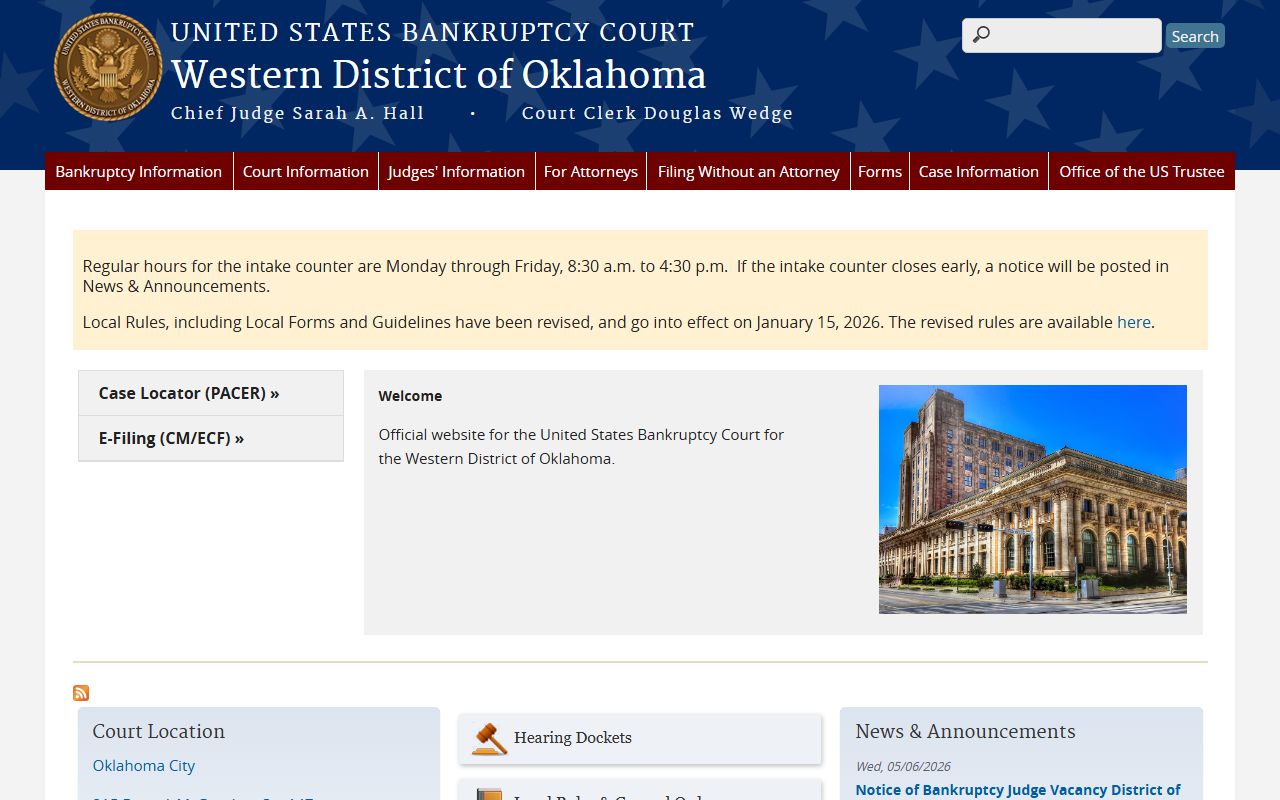
That court handles bankruptcy filings, not Blaine County criminal cases, and it is a separate body from the district court that hears federal crimes.
The same bankruptcy court keeps a case-information page that points users to CM/ECF, copies, claims, and PACER account links.
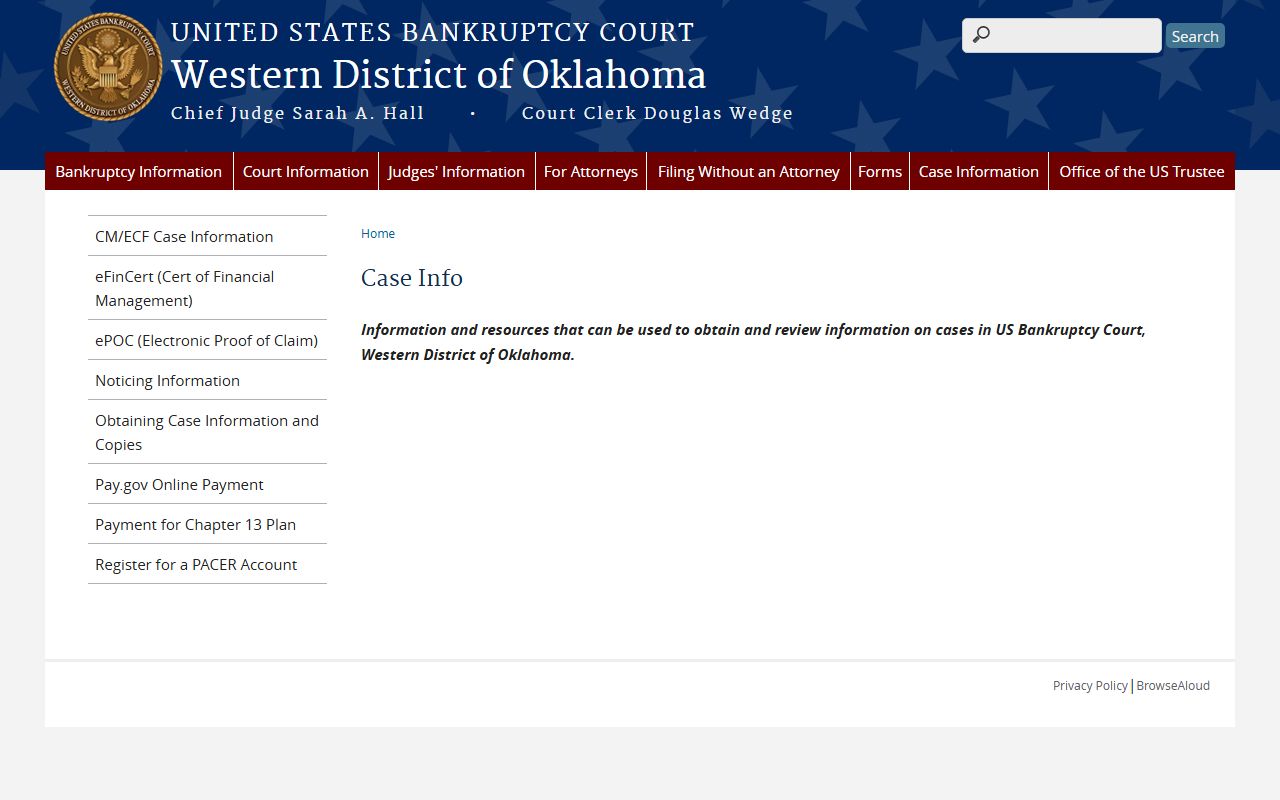
This page covers federal bankruptcy matters only, so a Blaine County criminal case file will never be found here.
Federal crimes in this area are prosecuted by the U.S. Attorney's Office for the Western District of Oklahoma.
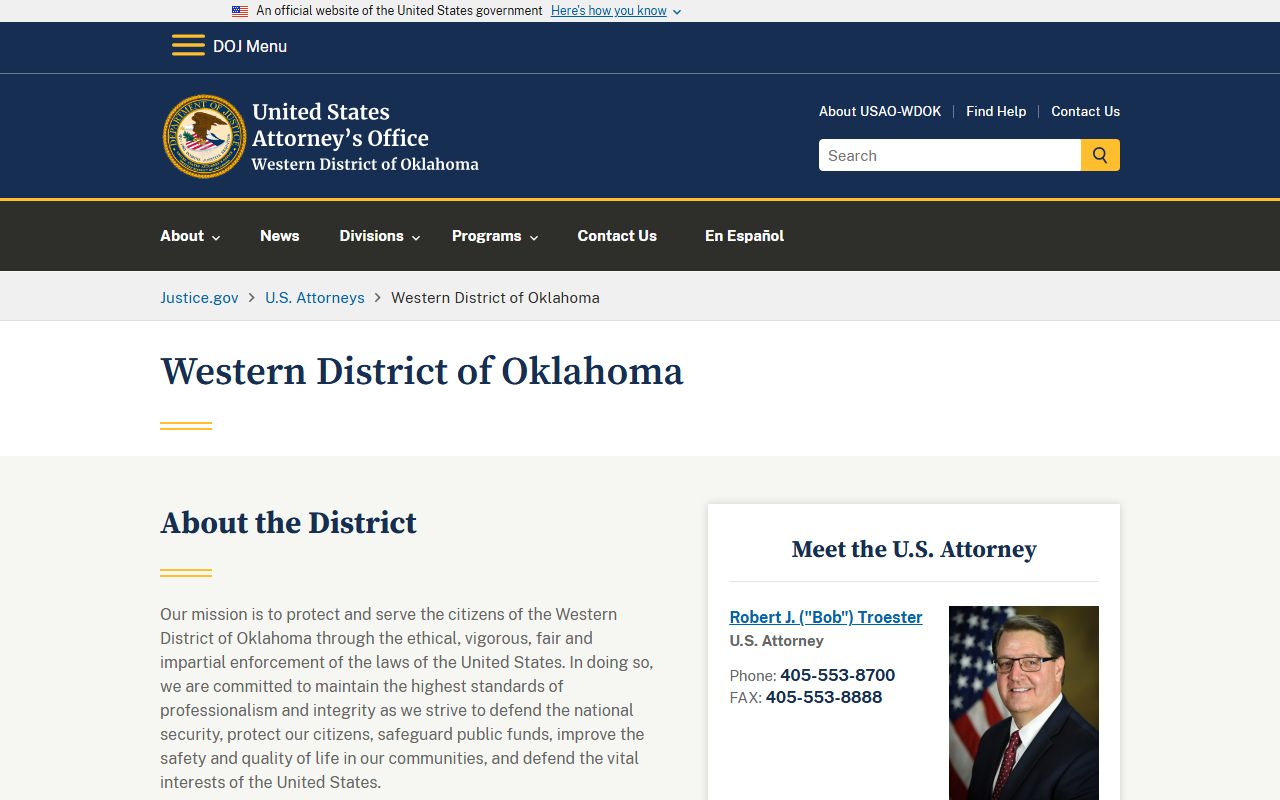
This office is the federal counterpart to the District 4 district attorney who files Blaine County criminal charges, but it works only on federal cases.
The Department of Justice describes the Western District of Oklahoma as the state's largest federal district, covering 40 of Oklahoma's 77 counties, Blaine among them.
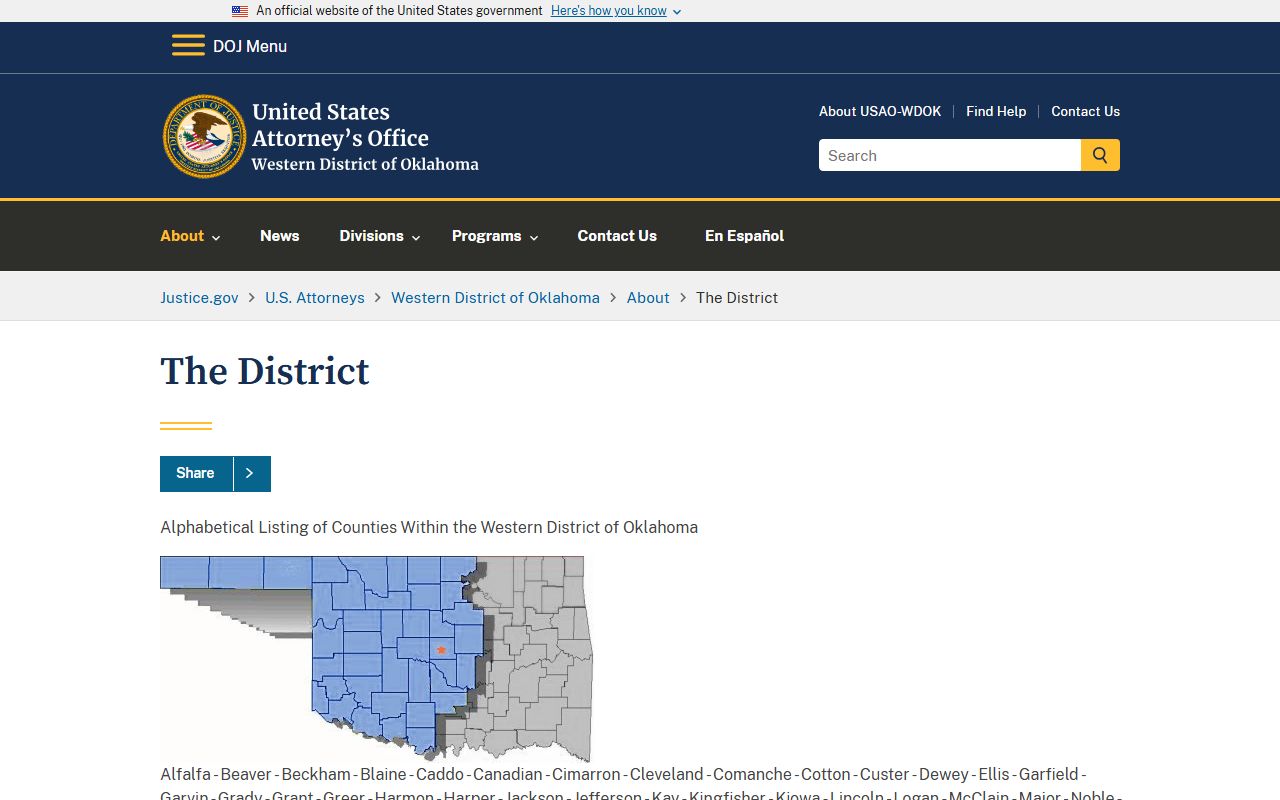
Being inside that federal district is why a Blaine County matter can become a federal case, yet the county court record and the federal record stay separate files in separate systems.
Booking Records vs. the Court Case File
The jail side of a case and the court side are two different records. The Blaine County Sheriff runs the jail and books people in. That booking record shows custody status and the charges as the arresting agency listed them. The Blaine County court case file shows the charges the prosecutor actually filed and what the judge decided. The two can differ, and only the court record carries the final disposition and sentence.
The custody side even has its own public tools. The Blaine County Jail runs personal inmate visits through NCIC, whose video-visitation page lets approved visitors set up an account and schedule a session.
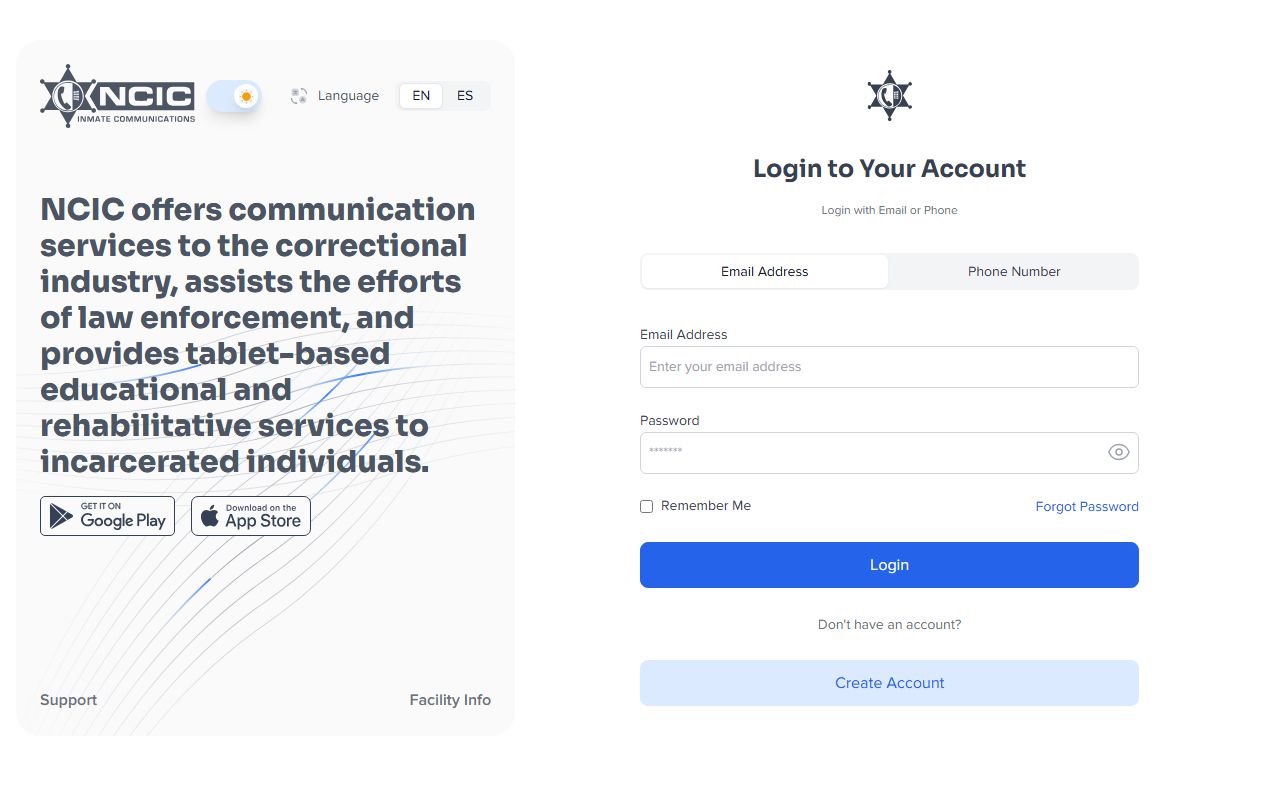
That page is run by the Sheriff for jail visitation, so it reflects custody, not the court case file or any charge the prosecutor filed.
Sealed vs. Expunged Criminal Records
Some criminal records are removed from public view. Oklahoma law separates sealing from expungement, and the practical effect differs. Sealing hides a record from public search while keeping it on file. Expungement treats the eligible record as though it never existed.
| Sealed | Expunged | |
|---|---|---|
| Visibility | Hidden from public search | Treated as never existing |
| Law Enforcement | Limited access | Very limited access |
| Eligibility | Set by court order under state law | 22 O.S. 18, 19, or 991c |
Expungement of a Blaine County record runs through the court, not a website. Eligibility falls mainly under 22 O.S. 18, 19, and 991c, the sections the Oklahoma State Bureau of Investigation cites for criminal-history record expungement. OSBI cannot pre-approve eligibility, and the State may still object even when a person qualifies.
- Confirm eligibility under Oklahoma law, mainly 22 O.S. 18, 19, or 991c.
- File a petition or motion in the court where the record exists, here the Blaine County District Court.
- Serve the required agencies and attend any hearing the court sets.
- Obtain a signed, certified order if the judge grants the request.
- Send the certified order to OSBI, which updates court records about a month after it receives the order.
Note: OSBI says physical fingerprint cards are not destroyed in an expungement, though the identifying data is no longer tied to the sealed arrest record.
Public Access to Blaine County Criminal Records
Oklahoma treats court records as open by default. The Open Records Act sets the rule, and court rules add detail for the online case search. Blaine County felony and misdemeanor case files are public, so anyone can read a charge, a plea, and a disposition without showing a reason. Confidential categories are the exception, not the norm.
Key Statutes:
Oklahoma Statutes § 51-24A.5 - public records stay open for inspection and copying during business hours, with named exceptions.
Oklahoma Statutes § 10A-1-6-102 - certain juvenile records are confidential and not open to the general public.
Restricted Blaine County Criminal Records
Not every criminal matter is open. Juvenile cases are confidential under Oklahoma's juvenile code and are not ordinary public dockets. Sealed and expunged Blaine County cases drop out of public search once a court orders it. Mental-health proceedings carry their own statutory limits. Even in an open file, personal identifiers such as Social Security numbers, full dates of birth, and victim addresses are redacted or left out.
When an online record is incomplete, ambiguous, or restricted, the Court Clerk decides what the law allows to be released. The clerk's office at 212 N. Weigle in Watonga is the local source for certified criminal copies and for files that are not posted online. For records held on paper, a docket line may read that a document is available at the Court Clerk's Office rather than for online viewing.